A thunderbolt can identify a figure, propel a story or organise the pose of a small bronze. To read it well, begin with the particular text or object in front of you. “Zeus has a thunderbolt” is a useful orientation; it is not yet an interpretation of every image.
Begin with the source, not a universal definition
In Hesiod’s Theogony, Zeus takes up thunder, lightning and the thunderbolt in the conflict with Typhoeus. The scene is an action within one poem: the imagery contributes force, heat and cosmic scale. It does not state a single abstract meaning that must apply wherever a zigzag shape appears.
A Perseus reference entry gathers another thread: the Cyclopes provide Zeus with thunderbolts after he releases them. That account links the attribute to making, alliance and conflict. It also shows why a reader should cite the text or tradition being summarised rather than presenting a blended modern synopsis as “the myth.”
Look at how an object carries the attribute
The Getty’s study of bronze statuettes discusses figures posed with a raised arm that may once have held a thunderbolt. Surviving attributes matter because the same pose can prompt competing identifications. The publication includes a case debated as Zeus or Poseidon, reminding us that findspot, comparison and missing objects all affect an attribution.
Describe what survives before completing what is missing: a raised right arm, an open hand, a socket, a nearby inscription. Then explain why a scholar proposes a thunderbolt. The distinction between observation and reconstruction lets the reader see the reasoning rather than only the result.
Separate ancient attribute from modern graphic shorthand
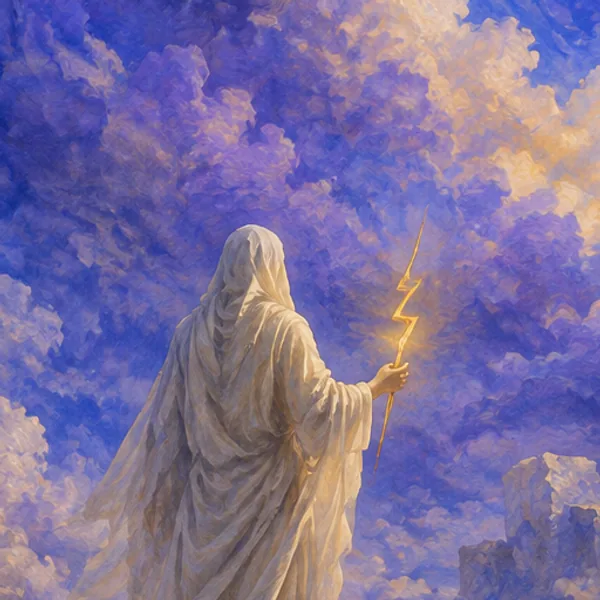
A modern illustrator can compress the thunderbolt into a clean golden line. That line works immediately because it is isolated, bright and held like an emblem. Its color and geometry belong to the new composition; they are not copied evidence for how every ancient artist represented lightning.
Our image places an anonymous figure among architectural fragments and violet clouds. The combination suggests a mythic realm, but the arch and cloudscape are inventions. The correct caption identifies the work as contemporary rather than asking it to stand in for a vase painting, sanctuary or lost statue.
Ask three questions of the symbol
First: what source identifies the figure? Second: what does the attribute do in this particular image or episode? Third: which parts of the visual treatment come from the modern artist? Those questions are more reliable than assigning fixed meanings such as power, justice or fate without evidence.
The symbol is strongest as a reading tool when it opens a trail—from text to object, and from object to later interpretation. It becomes weakest when a familiar association replaces the work of looking.
Reading takeaway
Name the source, describe the surviving evidence and treat the modern lightning motif as an interpretation rather than an ancient fact.
Sources and scope
These references support the factual frame of this article. They do not endorse its contemporary illustrations or editorial interpretation.
- Perseus Digital Library, Tufts UniversityHesiod, Theogony, lines 853–868
Accessible translation of one ancient poetic episode in which Zeus uses thunder and lightning against Typhoeus.
- Perseus Digital Library, Tufts UniversityDictionary of Greek and Roman Biography and Mythology: Cyclopes
A reference entry tracing changed traditions and citing accounts in which the Cyclopes provide Zeus with thunderbolts.
- J. Paul Getty TrustRepresentations of Zeus/Jupiter in Bronze Statuettes from Albania
Scholarly museum publication on thunderbolt-bearing representations and the limits of identifying a damaged figure from pose alone.