A myth can feel familiar because modern summaries repeat a stable sequence. Ancient evidence is often less tidy. Poems, hymns, drama and later reference works may preserve different details, emphases or orders of events.
Treat a version as a version
Begin with a source label: “in the Homeric Hymn to Hermes,” “in Hesiod’s Theogony,” or “in a later mythographic account.” That phrase does not burden the story. It tells the reader whose arrangement is being followed and prevents details from drifting between texts without notice.
A commentary preserved by Perseus compares the Hymn to Hermes with an account attributed to Apollodorus. Events appear in different order and details vary, including when the tortoise is found and what happens to the cattle. The difference is evidence about transmission, not an error to be silently corrected.
Compare structure before judging contradiction
Make a short table with episode, source and function. One telling may linger on an invention or performance; another may compress it into the route toward a genealogy. Ask what genre the text belongs to and what role the episode plays in that work.
Not every difference creates two completely separate myths. A change in sequence, a missing episode and an alternative parentage are different kinds of variation. Describe the scale of the difference rather than using “contradiction” as a catch-all.
Translations are part of the reading trail
An English translation gives access to an ancient text, but it remains a translation made in a particular edition. Record translator and publication information when precision matters. Perseus provides catalogue records alongside texts, making it possible to distinguish work, edition and translation.
Avoid building an argument on a single English word without checking a note or specialist discussion. This journal links accessible texts for orientation; it does not claim to replace work with the original language or current scholarship.
Images create another kind of version
An ancient vase, a stage production and a contemporary illustration can each select a moment and give it a different visual emphasis. The image is not simply a neutral picture of the text. Pose, attribute, costume and setting all interpret the character.
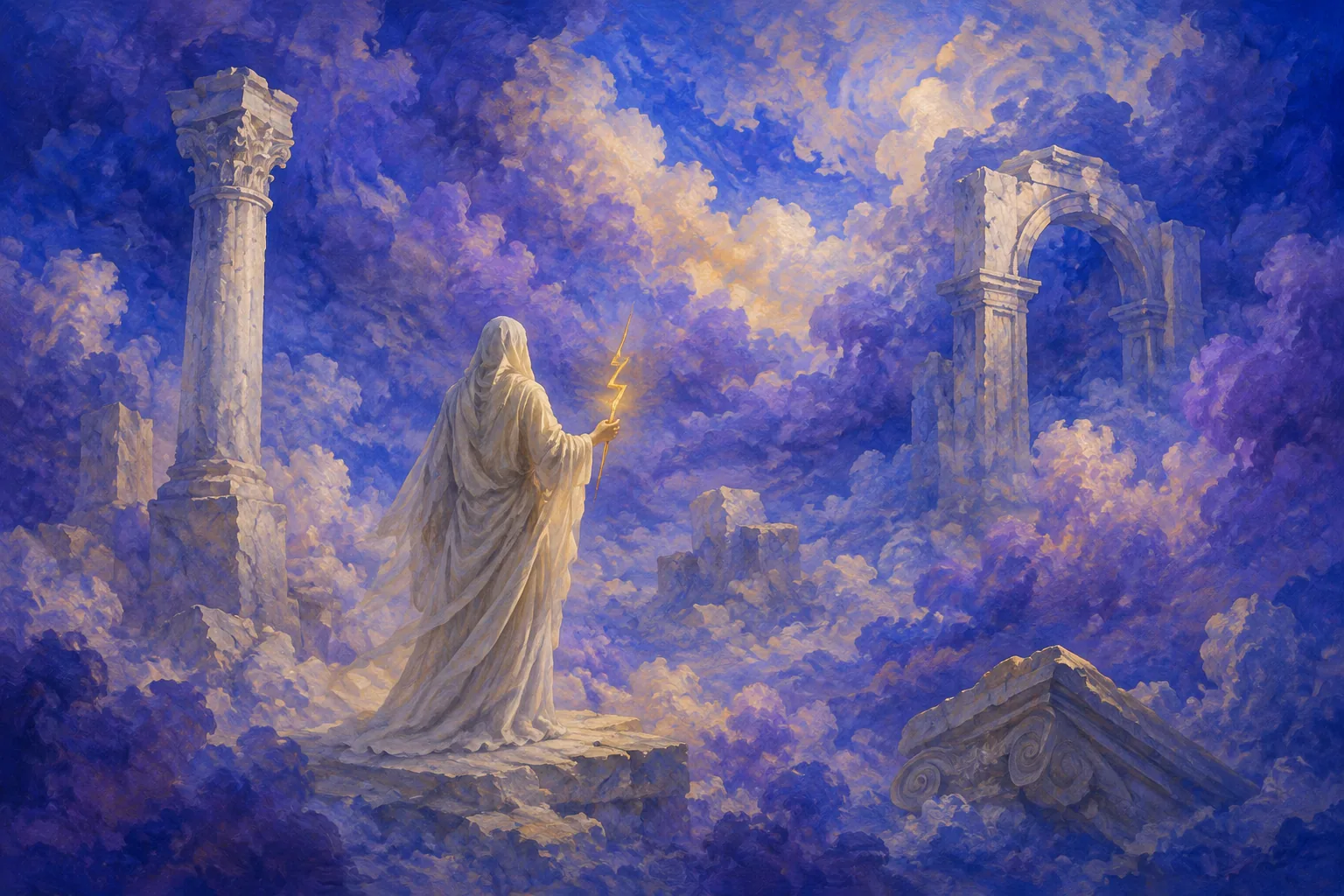
Our cloud scene deliberately refuses a precise episode. It is useful as an example of atmosphere, but not as an illustration of Hesiod or the Hymn to Hermes. An accurate caption protects that distinction.
Reading takeaway
Name the source, classify the difference and keep translations and images visible as acts of mediation.
Sources and scope
These references support the factual frame of this article. They do not endorse its contemporary illustrations or editorial interpretation.
- Perseus Digital Library, Tufts UniversityCommentary on the Homeric Hymn to Hermes
A concrete comparison between versions of the Hermes story and the order or details in which events are told.
- Perseus Digital Library, Tufts UniversityHesiod, Theogony, lines 853–868
Accessible translation of one ancient poetic episode in which Zeus uses thunder and lightning against Typhoeus.
- Perseus Digital Library, Tufts UniversityDictionary of Greek and Roman Biography and Mythology: Cyclopes
A reference entry tracing changed traditions and citing accounts in which the Cyclopes provide Zeus with thunderbolts.