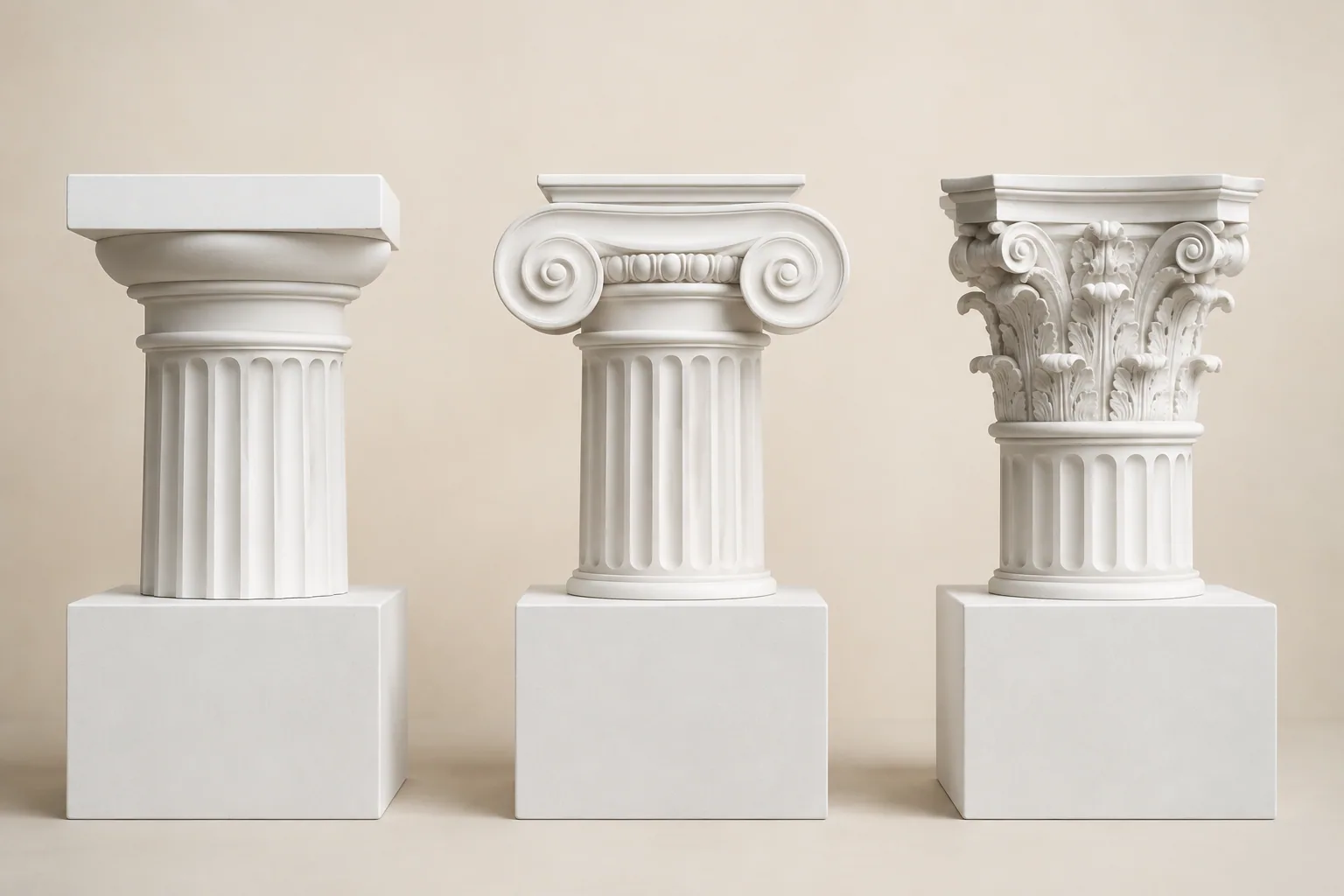
The three familiar names describe systems, not just decorative tops for columns. A capital is the quickest visual clue, but an architectural order also relates shaft, base, entablature and ornament.
Doric: a base is as revealing as a capital
In the Met’s account, a Greek Doric column is fluted and has no separate base. Its capital joins a cushion-like echinus to a flat abacus. Above, the frieze alternates triglyphs with metopes. Look for this sequence instead of relying on the impression that Doric simply means plain.
Our white model exaggerates the capital so the broad slab and rounded transition can be compared at a glance. It omits the entablature, scale and building context; it therefore illustrates a recognition clue rather than an entire order.
Ionic: follow the scrolls and horizontal bands
Ionic columns stand on bases and their capitals carry paired volutes. The Met also distinguishes the Ionic entablature by its horizontal bands and continuous frieze. A frontal view makes the two main scrolls obvious, while a corner condition poses a more complex design problem.
The generated studio model offers a clean, symmetrical face with prominent volutes. It is useful for comparison, but it should not be matched to a specific island, date or building. Real examples vary, and their measurements and condition matter.
Corinthian: later development, dense capital
The Met places the development of the Corinthian order in the late Classical period and notes its greater prevalence in Hellenistic and Roman architecture. The capital uses a bell-shaped core with acanthus leaves, spirals, palmettes and small corner volutes.
Our model deliberately concentrates leafy relief in the capital. That visual density separates it from the other two studies, but the image does not reproduce a documented carving. “Corinthian-inspired study” is a more accurate caption than the name of a real monument.
Use the whole system to check your first impression
Ask whether the column has a base, how the flutes meet, what happens in the frieze and how the capital addresses a corner. The Met’s educational diagram labels these parts side by side. A fragment may allow specialists to reconstruct relationships, but readers should not invent the missing building from one leaf.
The orders also travelled and were revived. A later building can use an Ionic portico without becoming an ancient Greek temple. Date, material and construction still require independent evidence.
Reading takeaway
Use the capital as an entry point, then verify base, shaft and entablature. The order is a coordinated system, not a style rating.
Sources and scope
These references support the factual frame of this article. They do not endorse its contemporary illustrations or editorial interpretation.
- The Metropolitan Museum of ArtArchitecture in Ancient Greece
Temple plans, building materials and the main characteristics and development of the architectural orders.
- The Metropolitan Museum of ArtGreek Art: From Prehistoric to Classical — Greek Orders of Architecture
Museum educational diagram and terminology for Doric, Ionic and Corinthian architectural elements.
- British MuseumGreek Revival architecture: simplicity and splendour
A documented nineteenth-century reuse of Greek architectural language that is not a literal copy of an ancient building.