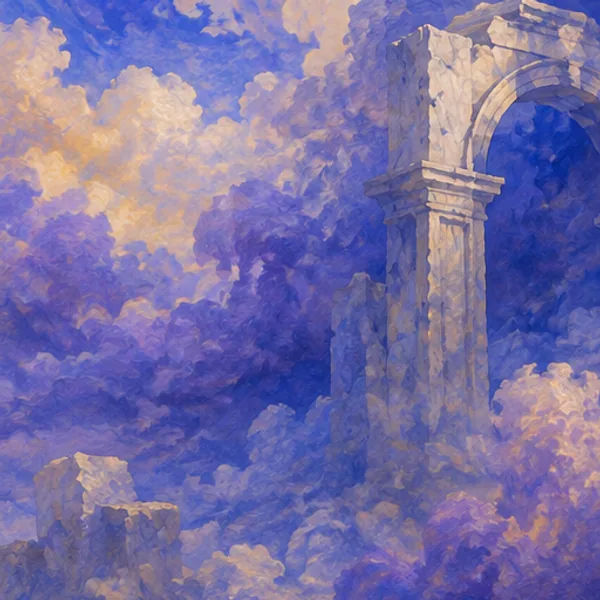
“Olympus” can name a place in myth, a real mountain and an artistic shorthand for divine distance. An image may shift between those meanings in a single frame. The reader’s task is to identify which kind of claim is being made.
Notice the visual shortcuts
Artists can signal elevation without drawing a measured landscape: clouds cover the ground, stairs continue beyond the frame and a figure is surrounded by radiance. Monumental columns can make the setting feel ordered or remote even when they do not correspond to a documented sanctuary.
Our illustration uses precisely these shortcuts. Violet cloud banks replace terrain, scattered column fragments float without engineering logic, and a golden zigzag supplies a mythic attribute. These are compositional devices, not a reconstruction proposal.
Architecture can imply authority
A central axis and a large arch guide the eye toward a privileged point. Repetition gives the imaginary space a ceremonial rhythm. Yet the arch also reveals that the artist is combining periods and languages rather than rebuilding a Classical Greek temple.
The Met’s account of Greek temple architecture offers a useful check: oblong planning, ordered elements and a sequence of porch, inner room and possible surrounding columns. When a fantasy environment departs from that structure, the departure can be named as invention rather than disguised.
Later revivals are historical too
The British Museum explains how its nineteenth-century building drew on Greek architecture while using modern construction and a new institutional purpose. That example shows why “classical” does not mean “ancient.” A revival can be historically documented on its own terms.
Modern fantasy is another stage of reuse, though it need not claim a direct lineage from every revival. Compare what is borrowed—column, pediment, ornament, symmetry—with what is changed—scale, setting, material effect and narrative role.
Write a caption that locates the image
A useful caption states medium, date or edition, creator where known, and whether the site is real, reconstructed or invented. “Fantasy view of Olympus” is clearer than “Ancient Olympus” when the scene includes impossible structures.
If an artwork refers to a specific ancient text or monument, provide that evidence. If it only evokes antiquity, say so. Imagination remains interesting when its seams are visible.
Reading takeaway
Read height, cloud and architecture as artistic choices. Keep the real mountain, mythic realm and modern image distinct.
Sources and scope
These references support the factual frame of this article. They do not endorse its contemporary illustrations or editorial interpretation.
- The Metropolitan Museum of ArtArchitecture in Ancient Greece
Temple plans, building materials and the main characteristics and development of the architectural orders.
- British MuseumGreek Revival architecture: simplicity and splendour
A documented nineteenth-century reuse of Greek architectural language that is not a literal copy of an ancient building.